Thursday, May 17, 2018

Marcel Duchamp

Henri-Marcel-Duchamp was a French-American painter, sculptor, chess player and writer whose work is associated with Cubism, conceptual art, and Dada. His artwork is very intricate and usually uses only 1 or 2 colors. A lot of them use Cubism and those pieces are the more intricate pieces. His sculptures are also very intricate as well. Some of them contain multiple wheels, and some of them I don’t even know what they are. Readymades were found objects, which Duchamp chose and presented as art.


Thursday, May 3, 2018

Fauvism

     Fauvism is a style of painting with vivid expressionistic and nonnaturalistic use of color. It had success in Paris from 1905, but was short-lived. Even though it was short lived, it had an important influence on subsequent artists. Especially the German expressionists. Matisse was regarded as the movement's leading figure. Some Fauvism artists are Henri Matisse, André Derain, George Braque, Maurice de Vlaminck, Raoul Dufy, Marc Chagall, Kees Dan Vongen, Albert Marquet, Georges, Rouault, and Amedeo Modigliani


Goya

     Francisco Goya is from Fuendetodos, Spain. A lot of  oya’s art seems have some non-human creature. Most of Goya’s art uses a lot of dark tones, but uses just enough light tones to brighten the painting up. This gives the painting a cool effect. Some of Goya’s paintings are very weird. For example, one of them consists of a creature devouring a human body. 


Thursday, April 5, 2018

Arts and Crafts Movement

The Arts and Crafts Movement was an international movement in the decorative and fine arts that began in Britain and flourished in Europe and North America between about 1880 and 1920, emerging in Japan in the 1920s. It stood for traditional craftsmanship using simple forms, and often used medieval, romantic, or folk styles of decoration. It advocated economic and social reform and was essentially anti-industrial. Some artists are named William Morris, Gustav Stickley, Edward Burne-Jones, Harry Clarke, Eric Gill, and many more.


picture

Thursday, March 29, 2018

Rococo

      Rococo was a decorative 18th century European style, which was the last expression of the baroque movement. It pushed to the extreme the principles of illusion and theatricality, an effect attained by dense ornament, asymmetry, fluid curves, and the use of white and pastel colors combined with gilding, drawing the eye in all directions. The style of Rococo was mainly architecture but also influenced painting, sculpture, literature, music, and theatre. Some famous Rococo artsists consist of Giovanni Battista Tiepolo, Jean-Antoine Watteau, Henrietta Johnston, Jean-Honoré Fragonard, François Boucher, François Lemoyne, Jean-Baptiste-Siméon Chardin, Élisabeth Vigée Le Brun, Thomas Gainsborough, Jean-Baptiste Pater, and many more.


picture link

Thursday, March 22, 2018

Johannes Vermeer

      Johannes Vermeer was a Dutch painter who specialized in domestic interior scenes of middle-class life. There are 38 pieces of art attributed to him. There are a lot of sharp edges in his paintings and there is a nice contrast of dark and light colors in all of his paintings. All of the artwork I took a close look at had people in it. All of those people are extremely life like with great facial expressions.


Thursday, February 8, 2018

Jan Van Eyck

     Jan van Eyck was an Early Netherlandish painter who lived  in Bruges. He is often considered one of the founders of Early Netherlandish painting and one of the most significant representatives of Northern Renaissance art. The materials he used were oil paints.  Van Eyck has painted many religious commissions and portraits of Burgundian courtiers, local nobles, churchmen, and merchants. After looking at this painting closely, I can obviously tell that this painting is of a couple. The woman is pregnant and they probabaly want the child because the man is holding the woman’s hand which symbolizes his care for her. 

Sunday, February 4, 2018

Giotto

      Giotto was an Italian painter and architect from Florence during the late Middle Ages. He worked during the Gothic or Proto-Renaissance period. The painting that I viewed had a weird form of perspective. The angels at the top particularly stood out for me. Some were pointed almost completely down. I’ve never seen that angle used in anything before. Some were also pointed up. I have seen something like that before. One person also had his arms completely spread out which seemed strange to me. I can’t figure out why.

Tuesday, January 30, 2018

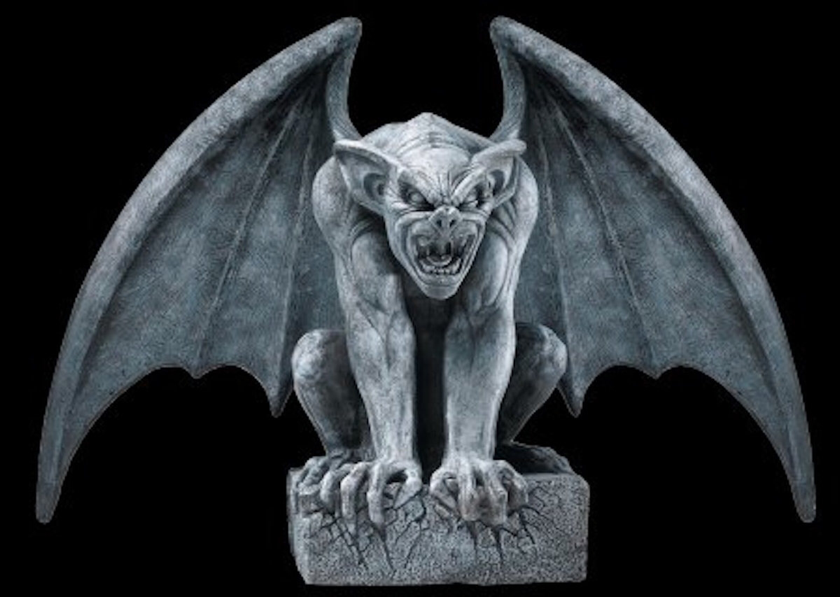
Gargoyles and Grotesques

             A gargoyle is a decorative sculpture that diverts water away from buildings. A grotesque is a very ugly, or comically distorted, creature or image.


Gargoyles 


Grotesques


Thursday, January 11, 2018

Byzantines and Mosaics


Byzantine Art


          The Byzantine Empire, also known as the Eastern Roman Empire, was the continuation of the Roman Empire in the East during Late Antiquity and the Middle Ages, when its capital city was Constantinople. Byzantine art that is still in good shape today is mostly religious. They followed traditional models that translate church theology into artistic terms. Mosaics were the main media, and figurative sculpture very rare except for small carved ivories. A mosaic is a piece of art or image made from the formation of small pieces of colored glass, stone, or other materials. Most mosaics are made of small, flat, rough square, pieces of stone or glass of different colors. This is known as tesserae.


Thursday, December 14, 2017

The Birth of Art: Basic Info


       The Roman Empire strechted from England to Egypt and from Spain to southern Russia.Because of the Romans’ exposure to foreign lands, they absorbed elements from older cultures, notably Greece. This mixed culture was transmitted to all of Western Europe and North Africa. Roman art became the building block for the art of succeeding periods. Romans later put there own spin on Greek art and philosophy. Roman art is less idealized and intellectual than Classical Greek, but more secular and functional. The Greeks shined at innovation, while the Romans’ forte was administration.

      With a huge amount of people in Rome, many of them were poor, distracted the them with public entertainment. The Colleseum seated 50,000 spectators. There was an opening act in A.D, 80, and the entire arena was flooded to stage a naval battle reenacted by a cast of 3000. Combat between gladiators was popular. Some were armed with a shield, sword, and a helmet. Others carried only a net and a trident. Boxers wore leather gloves. The reason why it was so popular and enthusiastic was because it was to the death. It was most likely the most popular form of entertainment in Rome.

      It was 1 p.m on a summer day when Mt. Vesuvius erupted, spewing molten lava and raining ash on the nearby towns of Pompeii and Herculaneum. A black mushroom cloud rose 12 miles over the peak until the villages were covered with 18 feet of ash and pumice. They remained covered and forgotten for 1700 years. Pompeii has a population of 25000 and was a luxurious resort community.

Wednesday, November 29, 2017

ARA PACIS

The Ara Pacis is an alter in Rome dedicated to Pax, the Roman goddess of Peace. The monument was commissioned by the Roman Senate on July 4, 13 BC to honor the return of Augustus to Rome after three years in Hispania and Gaul, and consecrated on January 30, 9 BC. It was originally located on the northern outskirts of Rome, a Roman Mile from the boundary of the pomerium on the west side of the Via Flaminia. It stood in the northeastern corner of the Campus Martius, the former flood plain of the Tiber River. It gradually became buried under 4 meters (13 ft) of silt deposits. It was reassembled in its current location, now the Museum of the Ara Pacis in 1938


Thursday, November 2, 2017

The Boston Museum of Science


               My time at the museum of science was pretty fun. There were really cool contraptions and tests to take to further our knowledge of science. My favorite game/test was the walking test. It calculated posture, calories burned, and grapes. Then it played it back on a monitor for you to see. Overall, the time with friends and contraptions and games/tests filled me with joy. It was really fun.

Thursday, October 12, 2017

Greek Theatre


      Theatre is one of the most important thing to early Greek cultures. The stages were massive and made of brick and wood. A truly amazing sight.  The biggest genres consisted of tragedy and comedy.
People thought of these two genres as completely separate. Because of that, they weren't mixed. One of the biggest aspects of Greek theatre is the visual art.

     One of the biggest visual arts were masks. The Ancient Greek term for a mask is prosopon, or face. Masks were a significant aspect in worshiping Dionysus at Athens. They were used for ceremonial rites and celebrations. A large amount of evidence strives from only a few vase paintings of the 5th century BC. One was showing a mask of the god suspended from a tree with decorated robe hanging below it and dancing. Another one was the Pronomos vase.The Pronomod vase portrays actors preparing for a Satyr Play. Unfortunately, no physical evidence remains available acceessible to the world. The reason is the masks were made of organic materials and not considered permanent objects .Conclusively being dedicated at the altar of Dionysus after performances. Still, the mask is known to have been used since the time of Aeschylus and considered to be one of the most well known conventions of classical Greek theatre.

   Masks were also made for members of the chorus, who play some role in the action and give a narration on the events in which they are caught up. Although there are twelve or fifteen members of the tragic chorus, they all wear the same mask to show they are considered to be representing one character. 


   The Ancient Greeks took their entertainment very vigoroursly and used drama as a way of investigating the world they lived in, and what it meant to be human. The three genres of drama were comedy, satyr plays, and most important of all, tragedy.

    The first comedies were mostly satirical and taunted men in power for their pride and absurdity. The first master of comedy was the playwright Aristophanes. Later on, Menander wrote comedies about everyday people and made his plays more like sit-coms.

     Tragedy handled the big themes of love, loss, pride, the abuse of power and the fraught relationships between men and gods. Usually, the main protagonist of a tragedy commits a crime without realizing how absurd and arrogant he has been. Then, as he slowly sees his mistake, the world crumbles around him. The three most famous playwrights of tragedy were Aeschylus, Sophocles, and Euripides.

     In conclusion, theatre is extremely important to Greek culture. It is well thought out and is supposedly an amazing show. The work put into the stages show just how much theatre meant to them. Without Greek theatre, television might not be what is is today.